

Is EcoGPT the Future of Sustainable Artificial Intelligence?
ChatGPT uses about 0.34 Wh of electricity and 0.32 mL of water each query.
Sounds too little? Not until you realize that billions of people generate prompts every day.
Even though each query uses only about 0.3 mL of water, billions of AI queries consume millions of liters of water every day. This can be equivalent to the daily water usage of an entire small city.
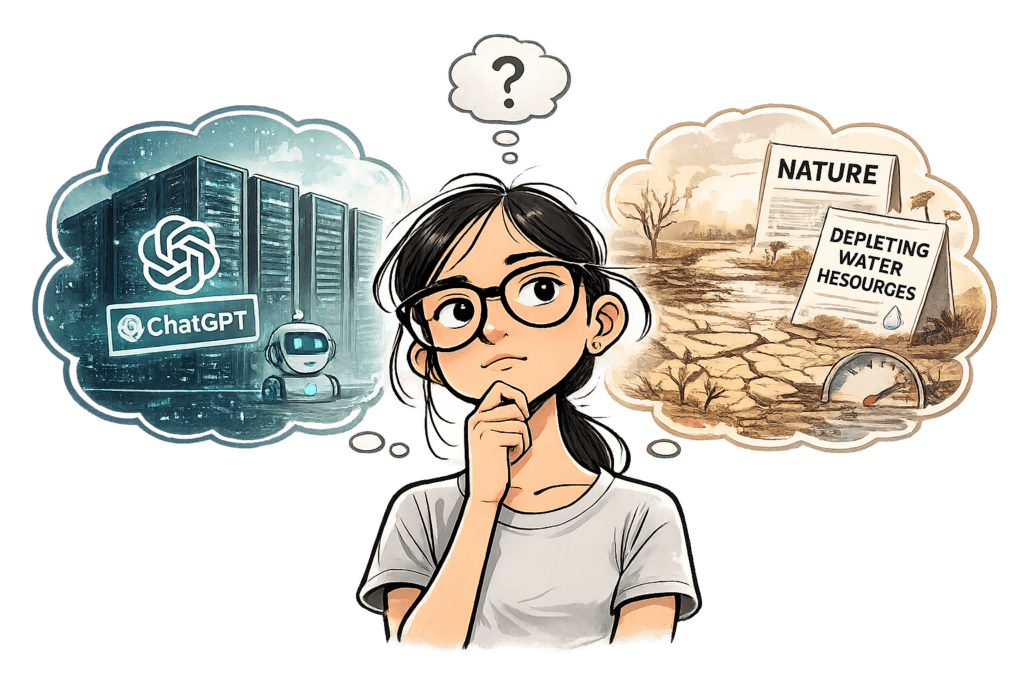
But Why Do AI Data Centers Use So Much Water?
AI data centers use GPUs (Graphics Processing Units) and TPUs (Tensor Processing Units) to process and generate responses.
Every time to type a prompt, intensive computations take place within these GPUs and TPUs to generate and deliver a response. Such large-scale and continuous processing generates a significant amount of heat.
Excessive heat can damage these processors, which is why vast amounts of water are used to cool them down.
This cooling process ensures that the powerful AI server chips continue to operate in safely and efficiently within their optimal temperature range.
Is AI Draining Our Planet’s Resources?
Usable freshwater make up only 0.3% of all water on Earth
At the same time, rising global temperatures, sea levels, climate change and freshwater depletion continue to put increasing pressure on our water resources.
The growing number of AI data centers further increases demand for this precious resource.
So, Should AI data centers have access to large amounts of freshwater if it comes at the expense of human needs?

EcoGPT- A Step Towards Sustainability
EcoGPT, Inc., a New York City-based Public Benefit Company, recently launched a new AI model similar to ChatGPT: EcoGPT.
A regenerative AI chatbot that pairs a ChatGPT-style chat interface with built-in environmental impact tracking.
The company calls itself “the world’s first Regenerative AI” and structures the entire product around a single promise: every conversation should give back to the planet.
How Does It Work?

There are essentially three layers running behind the scenes when you send a message.
1. You type a prompt into the EcoGPT app.
2. The query is routed to an open-source large language model running on Groq Cloud’s LPU infrastructure.
3. EcoGPT counts your messages, applies the “100 messages = 1 tree” model.

What Is The “100 messages= 1 Tree” Model?
EcoGPT follows a simple sustainability model: every 100 messages contribute toward the equivalent of planting one tree.
The key word here is equivalent.
Rather than planting a tree each time a user reaches 100 messages, EcoGPT allocates a portion of its subscription and advertising revenue to environmental initiatives.
These funds are then directed to reforestation partners, who carry out large-scale tree-planting projects.
As per the company’s own published breakdown, the largest concentrations are in Brazil (Amazon reforestation), Indonesia (mangrove restoration), Kenya (community forests), and India (agroforestry).
Trees are selected by partner NGOs in consultation with local communities, not by EcoGPT itself.
Should You Use It?
If you are a casual daily user who writes, brainstorms, summarizes, and asks everyday questions but does not rely on AI for complex or advanced creative work, EcoGPT may be worth considering.
For this type of workload, EcoGPT’s open-source models running on Groq infrastructure are fast and capable, while the eco-impact dashboard serves as an additional motivator.
While, it may not be as effective as ChatGPT for demanding tasks, it can be a good option for smaller everyday activities that don’t require heavy AI processing. At the same time, users contribute toward a step in supporting a more sustainable future.
“A natural world without AI would still be a wonderful place, but living in a world of AI without nature is a boundary we should never cross.” — Sophia Stiles